CRS State Tables 1-4
The annual Civil Registration System (CRS) report prints four State/UT tables of one shape: registered births, deaths, infant deaths and still births. Each row is a State/UT, then Male, Female and Person for Rural, Urban and Total.
The files are in examples/crs_state_tables/: recipe.toml and crs_state_table.py. The fixture holds Table 1 and Table 4 of the 2023 report, in tests/fixtures/crs/.
The recipe
name = "CRS State Tables 1-4"

[pages]
match = 'TABLE\s*-?\s*[1-4]\s*:\s*NUMBER OF .{0,30}REGISTERED BY SEX'

[engines]
ocr = false  # a text layer: the five default engines, 3 must agree

[parser]
type = "custom"
function = "crs_state_table.py:parse"
key = ["page", "state", "col"]

# ">=" because some States count Others/Not stated only in Person or Total
[[checks]]
column = "sex"
rule = "Person >= Male + Female"
by = ["page", "state", "area"]

[[checks]]
column = "area"
rule = "Total >= Rural + Urban"
by = ["page", "state", "sex"]

[output]
layout = "table"
rows = ["page", "label"]  # one row per table and State/UT
columns = "col"           # Rural_Male ... Total_Person
format = "csv"
match keeps only the four table pages of a full report. The parser reads rows as the generic parser does, then names each value’s area and sex, so the checks can use them.
parse() in crs_state_table.py, in outline (pseudocode):
def parse(pages):
    for page_no, lines in pages:
        seen = set()
        for label, values in lines split into text and values:
            skip a line without exactly 9 values
            no label: take the text lines just above and below, if they have no values
            a fake-bold label ("IIIInnnnddddiiiiaaaa") is read once ("India")
            state = the label in lower-case letters; skip it if seen on this page
            for col, value in zip(Rural_Male ... Total_Person, values):
                yield {"page", "state", "col", "label", "area", "sex", "value"}
Run it
pdfexorcist extract tests/fixtures/crs/crs_2023_t1_t4.pdf --recipe examples/crs_state_tables/recipe.toml -o crs_2023.csv
  pdftotext   666 readings  0.0s
  pdfplumber  666 readings  0.1s
  pymupdf     648 readings  0.0s
  camelot     648 readings  0.8s
  pdfium      648 readings  0.0s

Agreed          648  97.3% of cells
Unresolved       18  engines disagreed: left blank, not guessed
Checks      2 rules  all passed
page,label,Rural_Male,Rural_Female,Rural_Person,Urban_Male,Urban_Female,Urban_Person,Total_Male,Total_Female,Total_Person
1,India,,,,,,,,,
1,Andhra Pradesh,153272,137315,290587,244351,227155,471506,397623,364470,762093
1,Arunachal Pradesh,12565,12367,24932,9168,9297,18465,21733,21664,43397
...
1,Dadra and Nagar Haveli and Daman and Diu,1562,1353,2916,5149,4878,10032,6711,6231,12948
1,Lakshadweep,423,384,807,-,-,-,423,384,807
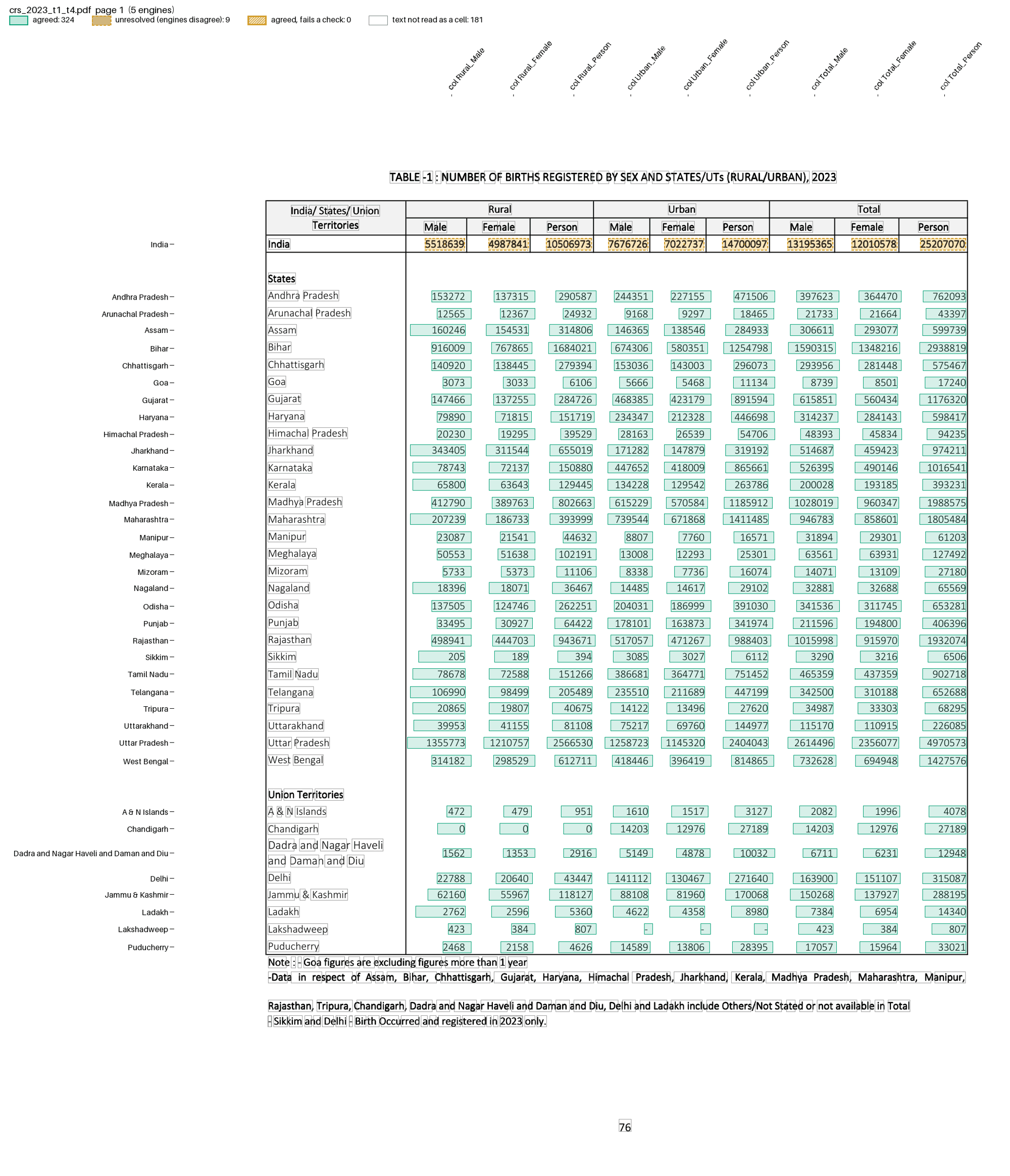
pdfexorcist show tests/fixtures/crs/crs_2023_t1_t4.pdf --recipe examples/crs_state_tables/recipe.toml -o page.png draws what the recipe reads:
What is unusual
The India row is printed in fake bold: each glyph is drawn four times, a little offset. The engines read it differently (pdfplumber reads 5518639 as 5555555511118888666633339999), so its cells are unresolved and listed in the review file.
“Dadra and Nagar Haveli and Daman and Diu” wraps around its row, half above and half below. A row without a label takes the text lines on either side.
camelot returns some rows a second time. A State is printed once a page, so the parser keeps its first row.
Every agreed value equals crsindia’s PDF-verified data (tests/test_crs_state_table.py).