SRS abridged life tables
The Sample Registration System (SRS) life-table report prints one State a page, titled like “Kerala, 2019-23”. Each page has Total, Rural and Urban blocks of 19 age rows (0-1, 1-5, 5-10 … 85+), and each row has 12 values: nqx, lx, nLx and ex for total, male and female.
The files are in examples/srs_life_table/: recipe.toml and srs_life_table.py. The fixtures are pages of the 2019-23 and 2010-14 reports, in tests/fixtures/srs/.
The recipe
name = "SRS abridged life table"

[engines]
ocr = false

[parser]
type = "custom"
function = "srs_life_table.py:parse"
key = ["page", "category", "age", "col"]

# l(x+n) = l(x) * (1 - nqx), within 3 for rounding
[[checks]]
function = "srs_life_table.py:survivorship"

[output]
layout = "table"
rows = ["state", "category", "age"]
columns = "col"
format = "csv"
The key holds the block and age, not the State. camelot returns the table without the title above it, so a key with the State would leave camelot out of every vote. The parser adds state as an extra column, and the output uses it to name rows.
Run it
pdfexorcist extract tests/fixtures/srs/srs_2019-23.pdf --recipe examples/srs_life_table/recipe.toml -o srs.csv
  pdftotext   2,052 readings  0.1s
  pdfplumber  2,052 readings  0.2s
  pymupdf     2,052 readings  0.0s
  camelot     2,052 readings  4.5s
  pdfium      2,052 readings  0.0s

Agreed       2,052  100.0% of cells
Unresolved       0
Checks      1 rule  all passed
state,category,age,total_nqx,total_lx,total_nlx,total_ex,male_nqx,male_lx,male_nlx,male_ex,female_nqx,female_lx,female_nlx,female_ex
India,Total,0-1,0.02873,100000,97486,70.3,0.02855,100000,97500,68.5,0.02893,100000,97502,72.5
India,Total,1-5,0.00420,97127,387516,71.4,0.00411,97145,387606,69.5,0.00429,97107,387375,73.6
...
West Bengal,Urban,0-1,0.01623,100000,98522,74.8,0.01636,100000,98511,73.5,0.01609,100000,98549,76.3
pdfexorcist show tests/fixtures/srs/srs_2019-23.pdf --recipe examples/srs_life_table/recipe.toml -o page.png draws what the recipe reads:
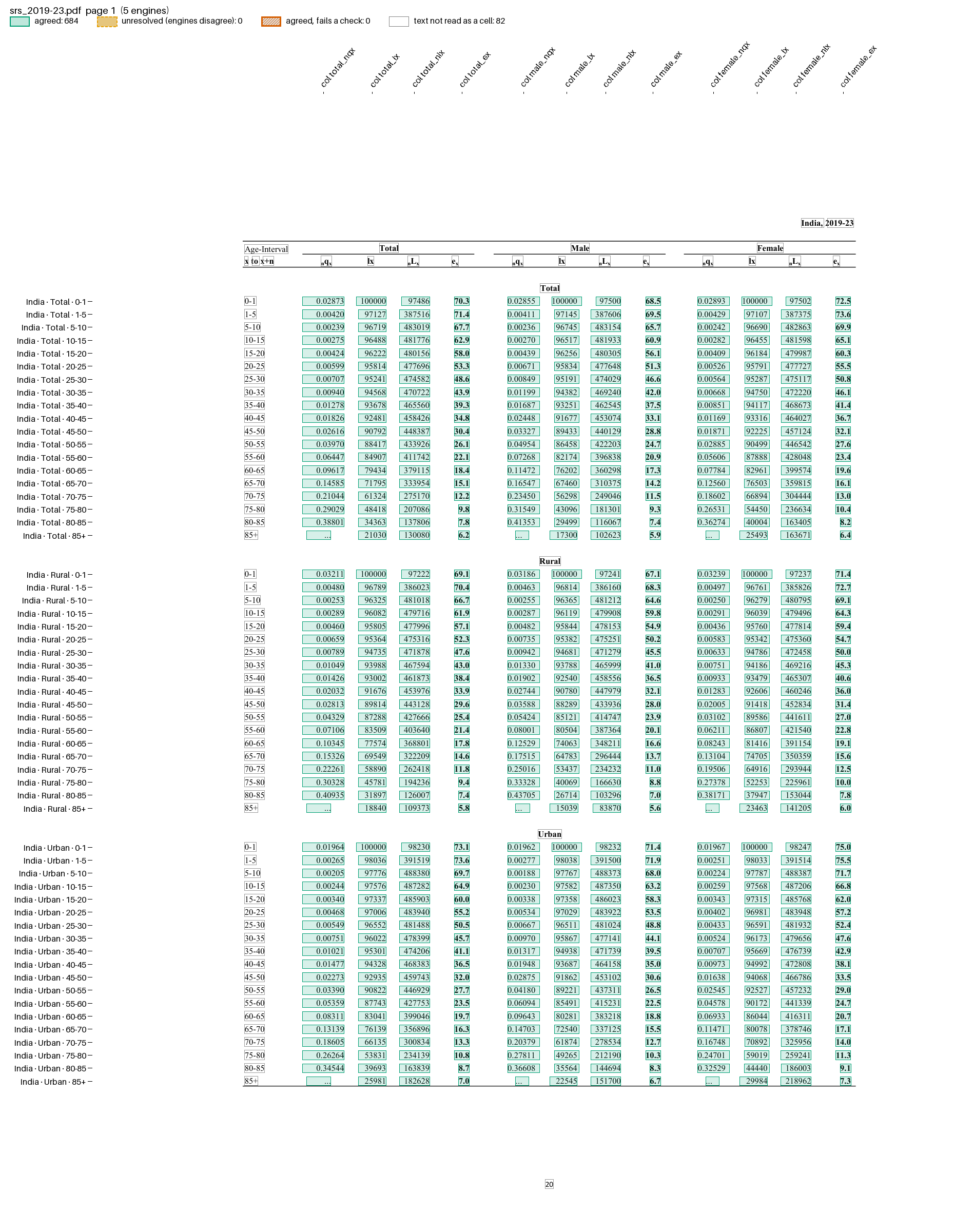
The parser and the check
parse() in srs_life_table.py, in outline (pseudocode):
def parse(pages):
    for page_no, lines in pages:
        for line in lines:
            label, values = the line's text, then its values
            "Kerala, 2019-23" with no values  -> state = "Kerala"
            "Total", "Rural" or "Urban" alone -> category
            an age label ("0-1" ... "85+") with exactly 12 values, inside a category:
                yield {"page", "category", "age", "col": total_nqx ... female_ex,
                       "state", "value"} for each value
survivorship is the check, as written:
@check("l(x+n) = l(x) * (1 - nqx)")
def survivorship(df: pd.DataFrame) -> pd.Series:
    """Each age's survivors follow from the previous age's lx and nqx (+/-3 for rounding)."""
For each sex and block it compares each age’s lx with the previous age’s lx * (1 - nqx), and marks the three cells involved when they are more than 3 apart.
What is unusual
survivorshipis a check written in Python: each age’s lx must follow from the previous age’s lx and nqx. A sum rule in TOML cannot express it.The 2010-14 report spells the State “Uttrakhand” and prints one Total row as
80+85.parsenames the State Uttarakhand and reads the row as 80-85.West Bengal’s urban female e0 is 76.3 in the re-uploaded 2019-23 report (73.5 in the first upload, per its corrigendum).
tests/test_srs_life_table.py compares every agreed value with srsindia’s corrected data.